1. E-Commerce
(1) Basic Information
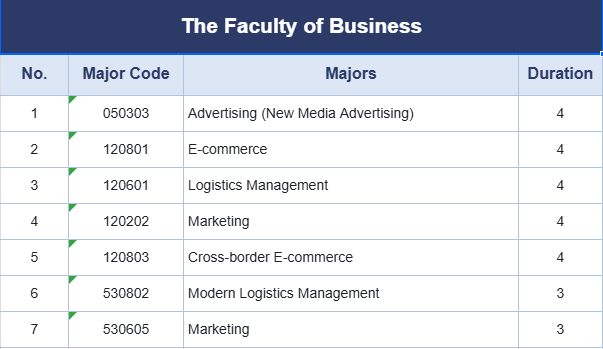
E-Commerce is an undergraduate program of Zhengzhou Shengda University. Grounded in Zhengzhou, it responds to the needs of China's digital economy development and regional industrial upgrading, and prepares students for professional roles in e-commerce planning, development, operation and management in enterprises and public institutions.
(2) Educational Objectives
Guided by the national education policy, grounded in Zhengzhou, and oriented toward the needs of national digital economy development and regional industrial upgrading, the program cultivates high-quality application-oriented professionals with all-round development in moral, intellectual, physical, aesthetic and labour education. Students systematically master the fundamental theories and frontier knowledge of economic management, new media technology and e-commerce, acquire core skills in new media technology, e-commerce operation and business data analysis, and develop sound Internet thinking together with innovation and entrepreneurship qualities. Graduates are able to undertake e-commerce planning, development, operation and management in enterprises and public institutions.
(3) Core Courses and Main Practical Training
The core curriculum covers Introduction to E-Commerce, Online Marketing, Digital Economics and other core courses, balancing knowledge of economic management, new media technology and e-commerce. Aligned with industry needs, the curriculum strengthens key areas such as e-commerce operation, business data analysis and supply chain management, and incorporates hands-on courses including E-Commerce Visual Design, Web Page Development and Database Technology. Courses such as Online Store Operation and Short Video Production are also offered, ensuring equal emphasis on theory and practice and comprehensively developing students' capabilities in operation, planning, data analysis and innovation.
The program features a distinctive practical training system centered on "dual-instructor classrooms plus real industrial projects," building a collaborative education mechanism. It connects with the needs of the regional e-commerce industry and cooperates deeply with enterprises such as JD.com and Kuke Technology to deliver enterprise-taught courses and introduce real project training. It reinforces the application of new media technologies in the AI era through core practical courses such as Comprehensive E-Commerce Practicum and Entrepreneurship Management Practicum, covering short video production, livestream e-commerce operation and other operational content. Concentrated practical teaching modules, credit recognition for innovation and entrepreneurship practice, and competition-based training further develop students' operational, data analysis, innovation and entrepreneurship capabilities.
2. Advertising (New Media Advertising)
(1) Basic Information
Advertising (New Media Advertising) is an undergraduate program of Zhengzhou Shengda University. Grounded in Zhengzhou and serving Henan Province, it builds a distinctive "new liberal arts + digitalization" education system and prepares students for careers in advertising planning, new media content creation and operation, and brand communication in advertising agencies, new media operation companies, media organizations, enterprises and public institutions.
(2) Educational Objectives
Grounded in Zhengzhou and serving Henan Province, the program constructs a distinctive education system featuring new liberal arts and digitalization, empowered across three dimensions: ideological and political education, creativity, and technology. It cultivates application-oriented professionals with a sense of national identity who meet the needs of the digital economy and society and achieve all-round development in moral, intellectual, physical, aesthetic and labour education. Students master the basic theories of advertising communication and new media marketing communication as well as the foundational knowledge of modern advertising, and acquire professional skills and practical competence in market research, planning and creativity, copywriting, brand communication and new media content creation. Graduates are able to engage in advertising planning, new media creation and operation, and brand communication in advertising agencies, new media operation companies, media organizations, enterprises and public institutions.
(3) Core Courses and Main Practical Training
The core curriculum is structured around four dimensions—theoretical foundations, practical skills, strategic application and technology empowerment—covering the entire advertising process from preliminary research and mid-stage planning and creativity to final implementation and execution, while connecting with the underlying logic of marketing. Core courses include Principles of Marketing, History of Chinese and Foreign Advertising, Computer Graphic Design, Advertising Planning and Creativity, Advertising Psychology, Marketing Research, Consumer Behavior, and Big Data Analytics and User Profiling.
Practical teaching is characterized by progressive stages, industry–education integration and the integration of learning and application. It is divided into four progressive levels: design fundamentals, comprehensive advertising design, applied practice, and internship and field training. Closely following the development trends of the new media advertising industry, it balances the cultivation of basic skills, comprehensive abilities and professional qualities, forming a closed loop of skill development, practice-based testing and career transition.
3. Logistics Management
(1) Basic Information
Logistics Management is an undergraduate program of Zhengzhou Shengda University. Oriented toward regional economic development, it prepares students to undertake complex professional work in digital supply chain planning, design and management, and smart logistics system optimization and operation management in enterprises and public institutions.
(2) Educational Objectives
Oriented toward regional economic development and the upgrading of industrial chains in the new era, the program cultivates high-quality application-oriented professionals with all-round development in moral, intellectual, physical, aesthetic and labour education. Students acquire foundational knowledge in management, economics and artificial intelligence, develop strong capabilities in logistics and supply chain operation, management and system planning and design, and possess a sound sense of innovation and the ability for continuous learning. Graduates are able to engage in digital supply chain planning, design and management, and smart logistics system optimization and operation management in enterprises and public institutions.
(3) Core Courses and Main Practical Training
Core courses include Supply Chain Management, Logistics Systems Engineering, International Logistics Practice, Transportation Management and Practice, Smart Warehousing and Inventory Control, Procurement Management, Distribution Center Management, Smart Logistics Information Technology and Applications, and Smart Logistics.
Practical teaching closely matches the talent requirements of regional logistics management positions. Covered practical content mainly includes transportation management, procurement, distribution planning and operation, and logistics big data analysis and warehouse management. Relying on on-campus training laboratories, the program delivers comprehensive experiments such as logistics system modeling and simulation, logistics case analysis and solution design, logistics enterprise management sandbox simulation, and cross-disciplinary comprehensive training. Relying on high-quality off-campus practical education bases, it also organizes professional cognition, professional (post) internships and graduation internships.
4. Modern Logistics Management (Diploma Program)
(1) Basic Information
Modern Logistics Management is a diploma (junior college) program of Zhengzhou Shengda University. It targets the logistics project operations supervisor, logistics sales supervisor, logistics data analyst, international freight supervisor and related position groups in manufacturing, transportation, warehousing and postal services, and business services, preparing high-quality skilled personnel for smart warehousing and distribution, logistics transportation, logistics data analysis, logistics system planning and logistics project operation.
(2) Educational Objectives
Upholding the mission of cultivating talent for the Party and the country, the program cultivates high-quality skilled personnel who practice core socialist values and achieve all-round development in moral, intellectual, physical, aesthetic and labour education. Students attain solid scientific and cultural grounding, sound humanistic, scientific and digital literacy, professional ethics and an innovative mindset, together with a dedicated work ethic, craftsmanship spirit, strong employability and entrepreneurship capacity, and the ability for sustainable development. Mastering the professional knowledge and technical skills of the discipline, graduates are capable of working in smart warehousing and distribution, logistics transportation, logistics data analysis, logistics system planning and logistics project operation for the logistics project operations supervisor, logistics sales supervisor, logistics data analyst, international freight supervisor and related position groups in manufacturing, transportation, warehousing and postal services, and business services.
(3) Core Courses and Main Practical Training
The curriculum consists of general education courses and specialized courses. General education courses mainly include ideological and political theory, physical education, English, applied mathematics, artificial intelligence, military theory and training, mental health education, innovation and entrepreneurship education, and labour education. Specialized courses include Management, Introduction to Logistics Management, Commodity Science, Digital Supply Chain Operations, Logistics Laws and Regulations, Smart Transportation Operations, Smart Warehousing and Distribution Operations, Procurement and Supply Management, International Logistics and Freight Forwarding, Logistics Cost and Performance Management, Logistics Marketing and Customer Relations, Logistics Information Technology and Applications, Logistics Simulation, International Trade Theory and Practice, Logistics Data Acquisition and Analysis, Cross-Border E-Commerce Logistics, and Logistics Solution Design.
Based on the competencies required by relevant positions, the program organizes practical content mainly covering procurement, logistics planning, warehouse management and distribution organization and operation, transport dispatching and freight forwarding. Supported by on-campus training laboratories and off-campus partner enterprises, it completes concentrated practical modules including professional cognition internship, specialized training on logistics facilities and equipment, comprehensive warehousing and distribution training, simulated logistics enterprise operation, comprehensive logistics professional training, post internship, and social service and practice.
5. Marketing
(1) Basic Information
Marketing is an undergraduate program of Zhengzhou Shengda University. Adapted to the demands of the digital era, it cultivates high-quality application-oriented marketing professionals with both an international vision and localized practical capabilities for careers in market research, marketing planning and digital marketing management in such fields as the digital economy, smart manufacturing and green food.
(2) Educational Objectives
The program aims to cultivate high-quality application-oriented marketing professionals adapted to the demands of the digital era, emphasizing all-round development in moral, intellectual, physical, aesthetic and labour education and combining an international vision with localized practical capability. Students master modern marketing theories and the application of digital tools, and acquire core capabilities in data-driven decision-making, new media operation and intelligent marketing. Upon graduation, they are able to engage in market research, marketing planning and digital marketing management in such fields as the digital economy, smart manufacturing and green food.
(3) Core Courses and Main Practical Training
The undergraduate curriculum is characterized by the integration of traditional marketing theory and digital skills. Core courses include Principles of Marketing, Consumer Behavior, Marketing Research, Digital Marketing, Big Data Marketing and Marketing Data Analytics, systematically building students' capabilities in market insight, data analysis and planning execution. The curriculum emphasizes the integration of theory and practice, incorporating AI tool application, Python data processing and new media operation, and includes experimental components that support students' transition from knowledge comprehension to practical competence.
The program has established a four-in-one practical teaching system of "experiment–training–internship–innovation," offering multiple independent experimental courses such as Marketing Practice for New Ventures, Business Simulation and Comprehensive Digital Marketing Training to strengthen students' planning and execution abilities in real scenarios. Through school–enterprise cooperation in building internship bases, it conducts project-based learning and business solution design, promoting the integration of learning and doing. In addition, a personalized education platform provides skill-extension courses in AI marketing tools, livestreaming operation and brand design, comprehensively enhancing students' employability and industry adaptability.
6. Marketing (Diploma Program)
(1) Basic Information
Marketing (Diploma Program) is a junior college program of Zhengzhou Shengda University. Oriented toward position groups in sales management, customer service, marketing planning and big data marketing, it prepares high-quality application-oriented personnel for front-line work in market analysis, product sales, brand operation and digital marketing execution.
(2) Educational Objectives
The diploma program aims to cultivate high-quality application-oriented personnel with all-round development in moral, intellectual, physical, aesthetic and labour education and with sound professional qualities and craftsmanship spirit. Students master the basic theories and practical skills of marketing and digital marketing, and are able to competently perform front-line tasks such as market analysis, product sales, brand operation and digital marketing execution for position groups in sales management, customer service, marketing planning and big data marketing, with dual emphasis on employability and sustainable development capacity.
(3) Core Courses and Main Practical Training
Structured on "foundational theory + core skills," the curriculum features core courses including Principles of Marketing, Consumer Behavior, Marketing Research, Marketing Planning, Online Marketing, and Short Video and Livestreaming Operation, with emphasis on the integration of digital marketing tools and methods. The curriculum highlights practicality and position alignment, strengthening students' professional competence in selling and negotiation, brand planning, data analysis and new media operation, so that they can quickly adapt to the practical marketing needs of enterprises.
The program has built a dual-track practical system combining laboratory training and off-campus internships. Seven specialized training laboratories on campus—covering digital marketing, market research, business data analysis and more—support project-based and simulation-based teaching. Concentrated practical components account for nearly 30% of the program, including marketing simulation training, business simulation and a six-month post internship. Through school–enterprise cooperative bases, students conduct real project drills, comprehensively improving their hands-on ability, position adaptability and overall professional competence.
7. Marketing (Sino-Foreign Cooperative Program)
(1) Basic Information
Marketing (Sino-Foreign Cooperative Program) is a cooperative program of Zhengzhou Shengda University that integrates Chinese and foreign educational resources. It cultivates high-quality technical and skilled personnel with an international vision for positions in sales, planning and customer service, enabling them to conduct market analysis, marketing execution and big data marketing in both Chinese and English contexts.
(2) Educational Objectives
The program aims to cultivate high-quality technical and skilled personnel with an international vision, emphasizing all-round development in moral, intellectual, physical, aesthetic and labour education and integrating sound professional ethics, an innovative mindset and craftsmanship spirit. Students master professional knowledge and skills in market research, digital marketing and brand planning, and are able to engage in market analysis, marketing execution and big data marketing for position groups in sales, planning and customer service, while possessing strong English proficiency and cross-cultural communication competence.
(3) Core Courses and Main Practical Training
The curriculum integrates Chinese and foreign teaching resources and introduces core courses from the partner institution, such as Professional English, Workplace Communication Skills, Event Management, and Digital Marketing, PR and Communication, strengthening English teaching and international marketing practice. It also covers domestic core courses including Principles of Marketing, Consumer Behavior, Selling and Negotiation, and Short Video and Livestreaming Operation, forming a trinity curriculum structure of "language + major + internationalization" that supports students in conducting marketing practice in both Chinese and English environments.
The program adopts an internationalized practical teaching model, conducting project-based training via on- and off-campus training bases and introducing international teaching methods such as case teaching, group discussion and flipped classrooms. Practical components account for 50.45% of total class hours, with emphasis on skills training in digital marketing, business data analysis and new media operation. Joint teaching by Chinese and foreign faculty, overseas exchange programs and cross-cultural practice activities comprehensively enhance students' international competence and practical ability.
8. Cross-Border E-Commerce
(1) Basic Information
Established in 2021, the Cross-Border E-Commerce program of Zhengzhou Shengda University was designed to cultivate the application-oriented talents urgently needed by China's rapidly growing cross-border e-commerce industry. Its training scheme is jointly formulated by industry enterprises, cross-border e-commerce parks and the government, with reforms and innovations in training model, curriculum design and employment alignment. The program is characterized by interdisciplinary integration of foreign trade, e-commerce, logistics, payment, marketing and cross-cultural communication; strong practical orientation, including full-process operation of globally renowned platforms such as Amazon; and strong labour market demand—theNational "14th Five-Year" E-Commerce Development Planpredicts that China's cross-border e-commerce talent gap will exceed 3.94 million by 2025. Graduates find employment in four main directions: cross-border e-commerce enterprises (platform enterprises and enterprises operating on platforms); traditional foreign trade enterprises using cross-border e-commerce technology to upgrade their business; cross-border e-commerce service enterprises providing customs clearance, logistics, marketing, payment and settlement, and compliance support; and government departments in charge of cross-border e-commerce, providing policy support and regulatory services. The standard length of study is four years; students who meet the graduation requirements in accordance with theRegulations of Zhengzhou Shengda University on the Awarding of Bachelor's Degreesare awarded a Bachelor of Management degree.
(2) Educational Objectives
Grounded in Zhengzhou and serving Henan Province, the program closely aligns with the strategic development needs of the regional open economy. It cultivates high-quality application-oriented professionals with a global vision and cross-cultural communication competence and all-round development in moral, intellectual, physical, aesthetic and labour education. Students master the fundamental theories of cross-border e-commerce and knowledge of operation and management, and are capable of data-driven decision-making, familiar with international rules, and skilled at using digital tools to solve practical problems. Graduates are able to engage in cross-border e-commerce operation and management, overseas market development, international marketing planning and cross-border supply chain management in cross-border e-commerce enterprises, foreign trade enterprises in transformation, digital trade service platforms and related institutions.
(3) Core Courses and Main Practical Training
Core courses include Database Technology and Applications, Introduction to E-Commerce, Cross-Border E-Commerce, Supply Chain Management, Cross-Border E-Commerce Marketing, Cross-Border E-Commerce Visual Design, Cross-Border Payment and Settlement, Cross-Border E-Commerce Import and Export Practice, and Cross-Border E-Commerce Law and Regulation. Major practical courses include Comprehensive Cross-Border E-Commerce Training and Cross-Border E-Commerce Operation and Management.
The program highlights three distinctive features: a new "Internet Plus foreign trade" track, with the cross-border e-commerce sector expanding rapidly and a talent gap exceeding 3.94 million; industry–university–government collaboration, with industry experts providing hands-on mentoring, real project practice and alignment with real job requirements; and composite skill development, enabling students to learn operations, work with data, conduct marketing and understand the law, becoming truly all-round professionals in the cross-border business field.